
 Image 1 of 1
-
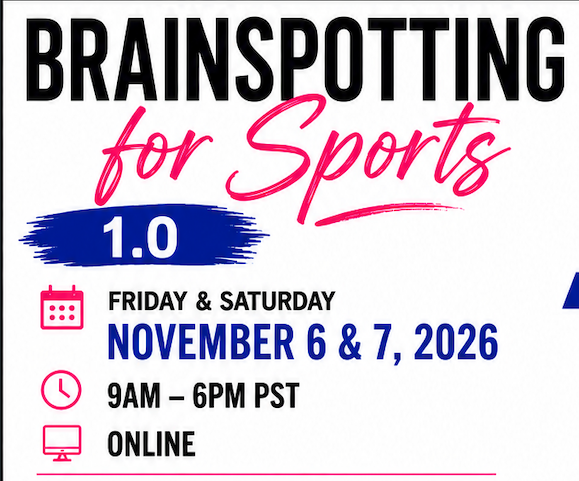
Brainspotting for Sports 1.0 is an experiential two-day professional training designed to provide clinicians, mental performance professionals, and other qualified practitioners with a neuroscience-informed framework for applying Brainspotting to sports performance, injury recovery, and nervous-system regulation. Participants will explore how psychological stress, physical trauma, sports injuries, and head injuries may influence autonomic nervous-system regulation, brain states, body arousal, cognitive anxiety, movement, and performance. The training examines Brainspotting as a brain-body processing approach for identifying and working with activation associated with performance blocks, the yips, balking, injury experiences, and health-related stressors. Participants will learn how to select, layer, pivot, and integrate Brainspotting frames while following the client’s physiological and emotional processing—the “tail of the comet.” Discussion will also explore emerging and theoretical applications of Brainspotting in relation to neuroinflammation, fascia, motor functioning, metabolic and autoimmune conditions, degenerative conditions, syndromes, and complex or unexplained symptoms, while distinguishing established evidence from developing clinical hypotheses. Through lecture, three instructor demonstrations, and three structured practicums, participants will move from conceptual understanding to direct observation and supervised experiential application.
Training runs from 9am - 6pm PST each day.
-
Upon completion of this two-day training, participants will be able to:
Describe foundational neuroscience concepts related to psychological and physical trauma and explain how Brainspotting is theorized to support nervous-system regulation and access states conducive to recovery and optimal performance.
Explain how sports injuries, repetitive physical stress, concussion/head injury, and psychologically stressful experiences may influence autonomic regulation, arousal, attention, movement, and brain-state functioning.
Differentiate physiological/body-based arousal from cognitive anxiety and identify Brainspotting strategies for addressing each presentation within sports and performance contexts.
Identify clinical and emerging theoretical considerations regarding Brainspotting, stress physiology, neuroinflammation, fascia, motor functioning, metabolic and autoimmune conditions, degenerative conditions, syndromes, and complex or unexplained symptom presentations.
Recognize and assess nervous-system activation associated with sports performance blocks, including the yips, balking, fear of reinjury, hesitation, and loss of automatic performance.
Demonstrate the appropriate selection and application of Brainspotting frames for sports performance optimization, injury-related experiences, performance anxiety, and performance blocks.
Apply layering and pivoting of Brainspotting frames while tracking client activation and processing in order to remain with the emerging clinical material or “tail of the comet.”
Integrate somatic, emotional, cognitive, and performance-related information when conceptualizing Brainspotting interventions for athletes and other high performers.
Communicate a clear, neuroscience-informed explanation of Brainspotting that supports informed client understanding, realistic expectations, and engagement in treatment or performance-focused work.
Observe and analyze three instructor demonstrations illustrating distinct Brainspotting applications and advanced use of frames within sports performance and recovery scenarios.
Complete three experiential practicums to practice Brainspotting setup, frame selection, attunement, activation tracking, layering, pivoting, and session processing.
Formulate an individualized Brainspotting approach for a sports-performance or recovery presentation while remaining within the participant’s professional scope of practice.
-
Day 1
Sports & Exercise Psychology 9-10am
Neuroscience 10-11am
Break 15 Minutes 11-11:15am
Mental, Physical & Environmental Traumas 11:15-12:15pm
Trauma Applied to The Nervous System 12:15-1:15pm
Lunch 60 Minutes 1:15-2:15pm
Brainspotting 2:15-3;15pm
Desensitization & Reset Demonstration 3:15-4:15pm
Break 15 Minutes 4:15-4:30pm
Desensitization & Reset Experiential 4:30-6:00pm
Day 2
Concussions 9-10:30am
Reprocessing-Deconditioning-Reset Demonstration Concussion 10:30-11:30am
Break 15 Minutes 11:30-11:45am
Reprocessing-Deconditioning-Reset Experiential 11:45-12:45pm
Lunch 60 Minutes 12:45-1:45pm
Athlete Archetypes 1:45-2:45pm
Desensitization-Visualization-Optimization Demonstration 2:45-3:45pm
Break 15 Minutes 3:45-4:00pm
Desensitization-Visualization-Optimization Experiential 4:00-5:30pm
Closing questions 5:30-6:00pm
-
Instructor:
Paige Roberts, PhD, MSW is a sports performance consultant, Brainspotting consultant and speciality trainer, and nervous system optimization expert who has worked with athletes and trained clinicians in applying brain-body approaches to sports performance, injury recovery, and mental blocks. With degrees in Human Performance & Wellness, Social Work, and Integrative Health, Paige blends Brainspotting, neuroscience, and performance psychology to help athletes move beyond injuries, performance blocks, and stress patterns and access greater focus, confidence, and flow. A lifelong athlete and Colorado mountain native now based in Topanga, California, Paige brings an engaging, experiential approach to trainings, conferences, and sports performance events.
To see the instructor information and bio for Laura Hillesheim, click on our about tab in the menu.Our Target Audience:
Classes are open to all licensed professional counselors, licensed social workers, psychologists, psychoanalysts, MFTs, Substance Abuse Counselors, and students who are curious and seek to expand their knowledge.Accessibility:
I am committed to ensuring that all our continuing education (CE) offerings meet the highest standards of accessibility. I invite you to reach out to me via the contact for of email with any specific accessibility needs or accommodations you may require. Please make me aware of your requests prior to the training to ensure an inclusive and supportive learning environment.Grievance Policy:
Participants who have a grievance related to my continuing education courses are encouraged to submit their concerns in writing via my contact form within 30 days of completing the course.The grievance should include:
Participant's name and contact information.
Course title, date of completion, and instructor's name (if applicable).
Detailed description of the grievance, including relevant facts and supporting documentation, if any.
Desired outcome or resolution sought by the participant.
Contact:
For questions or concerns, please reach out to:Laura Hillesheim
Laura Hillesheim Therapy
info@laurahillesheimtherapy.com
(920) 609-1539 -
"Brainspotting for Sports 1.0" has been approved for 15 hours of continuing education through NBCC, approved provider ACEP no. 7898.